
HSBC | 2022
Strategy - Growing Design Influence
Overview
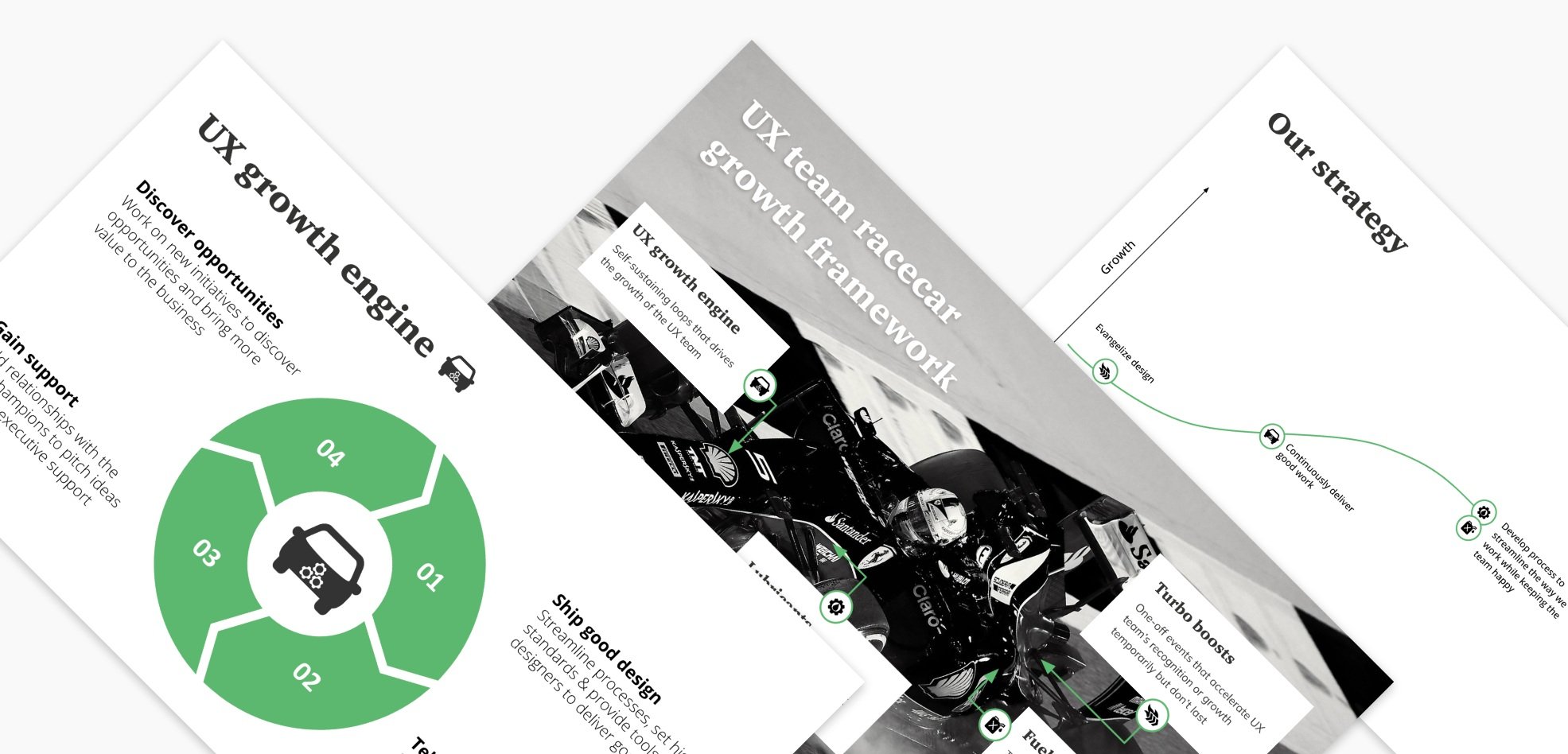
The design team at HSBC was treated as service providers, not valuable partners. Seeing that the design team’s survival will be at stake if this path continues, I developed strategies to grow the UX team’s influence within the organization systematically. I worked on 3 things:
UX growth model - explains What we should focus on
UX growth strategy - explains How we can grow the design team’s influence
UX growth roadmap - lays out step-by-step When we can get there
Outcome (to be measured): I departed the company shortly after this strategy was implemented. However, I have identified a few areas to measure success: Number of design proposed projects, Design maturity score, Team satisfaction rating, and Designer churn.
Problem
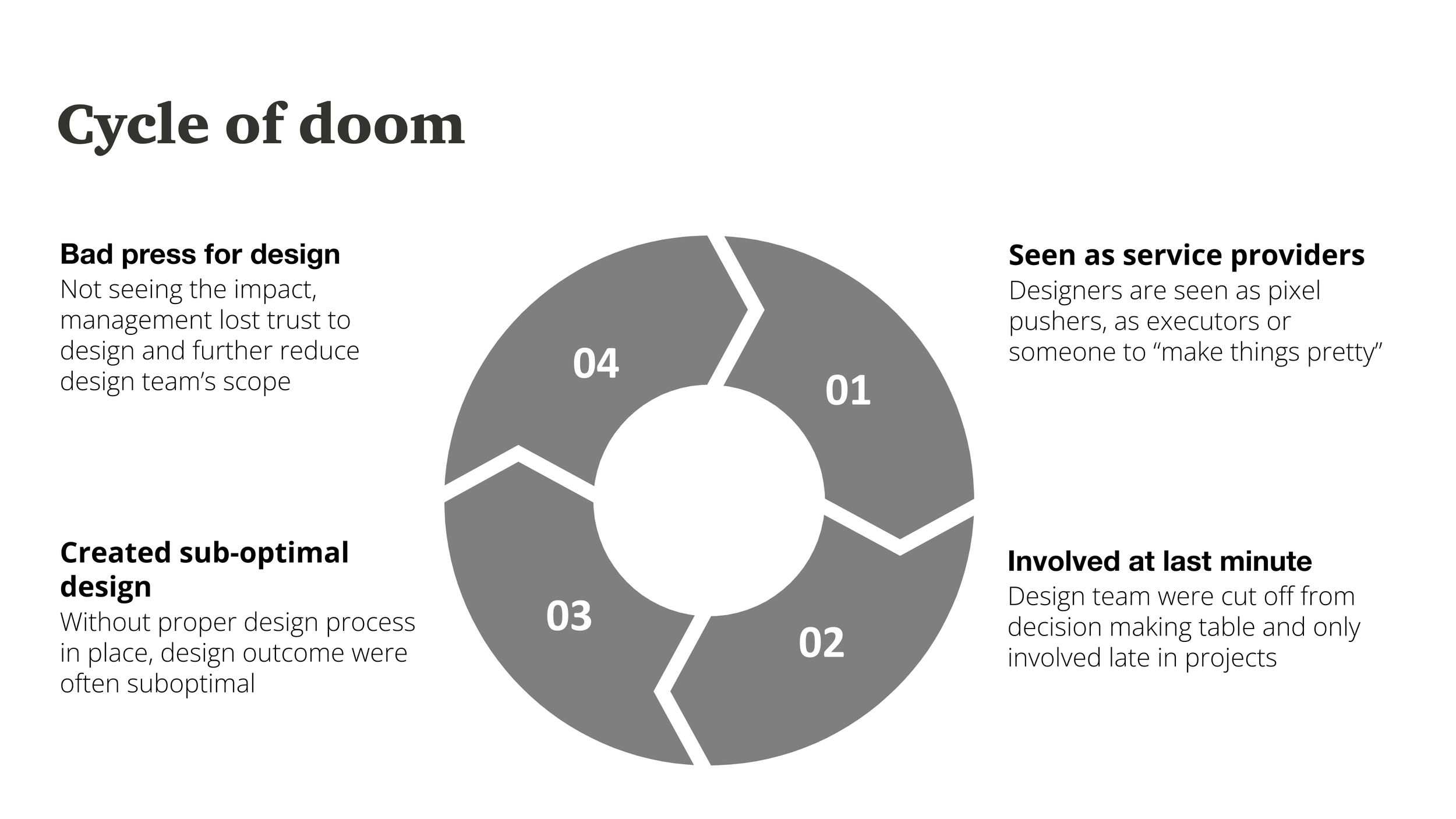
The design team was facing a huge problem. We were treated as service providers, not valuable partners. This cascaded into a chain of problems which I referred as “The cycle of doom”
Seen as service providers — Designers were seen as pixel pushers, someone to “make things pretty”
Involved in last minute — Designers were then cut off from the decision-making table and were involved late in projects
Created sub-optimal design — Without a proper design process in place, the design output was sub-optimal
Bad reputation for design — Not seeing great design work, management further alienates the design team and continues to treat it as a service provider
We cannot continue that way, or the design team’s survival will be at stake.
Challenge
We must grow the UX team’s maturity and influence within the organization. However, if we ask ten people around the team “How does the UX team grow?” we’ll get ten different answers.
Better design process? More company-wide Show & tell? This misalignment is a big problem because it’ll lead us spinning our wheels on misguided projects, ill-timed bets, and low-impact work.
These are all symptoms caused by a lack of strategy. A strong strategy would allow us to focus on what truly matters.
How might we…
“Grow the UX team? What should we focus on, How can we get there and When we can get there?”
The Plan
In order for the team to grow, we need to figure out what we needed to do, when, and why. There are 3 steps to this:
Create a UX growth model that explains What we should focus on. With this, we’ll know which growth investments to make right away, which can wait, and which we should avoid altogether
Create a UX growth strategy that explains How we can get there
Create a UX growth roadmap that layout step-by-step When we will get there
-
This casestudy focuses on UX growth strategy, it differs from UX strategy on the following:
UX growth strategy — is the logical plan on how to improve UX team’s influence within the organization. UX growth strategy focuses on the UX team.
UX strategy — is the logical plan on how to improve the UX of a product. UX strategy focuses on the Product team.

UX growth model
The Racecar growth framework
I developed the following model as a way to explain how the most successful UX team operates within and outside our organization. Imagine the UX team as a high-performing racecar. The components of how a racecar functions are similar to how we run a UX team. They are:
The Engine
Lubricants
Fuels
Turbo boost

⚙️ The UX growth engine
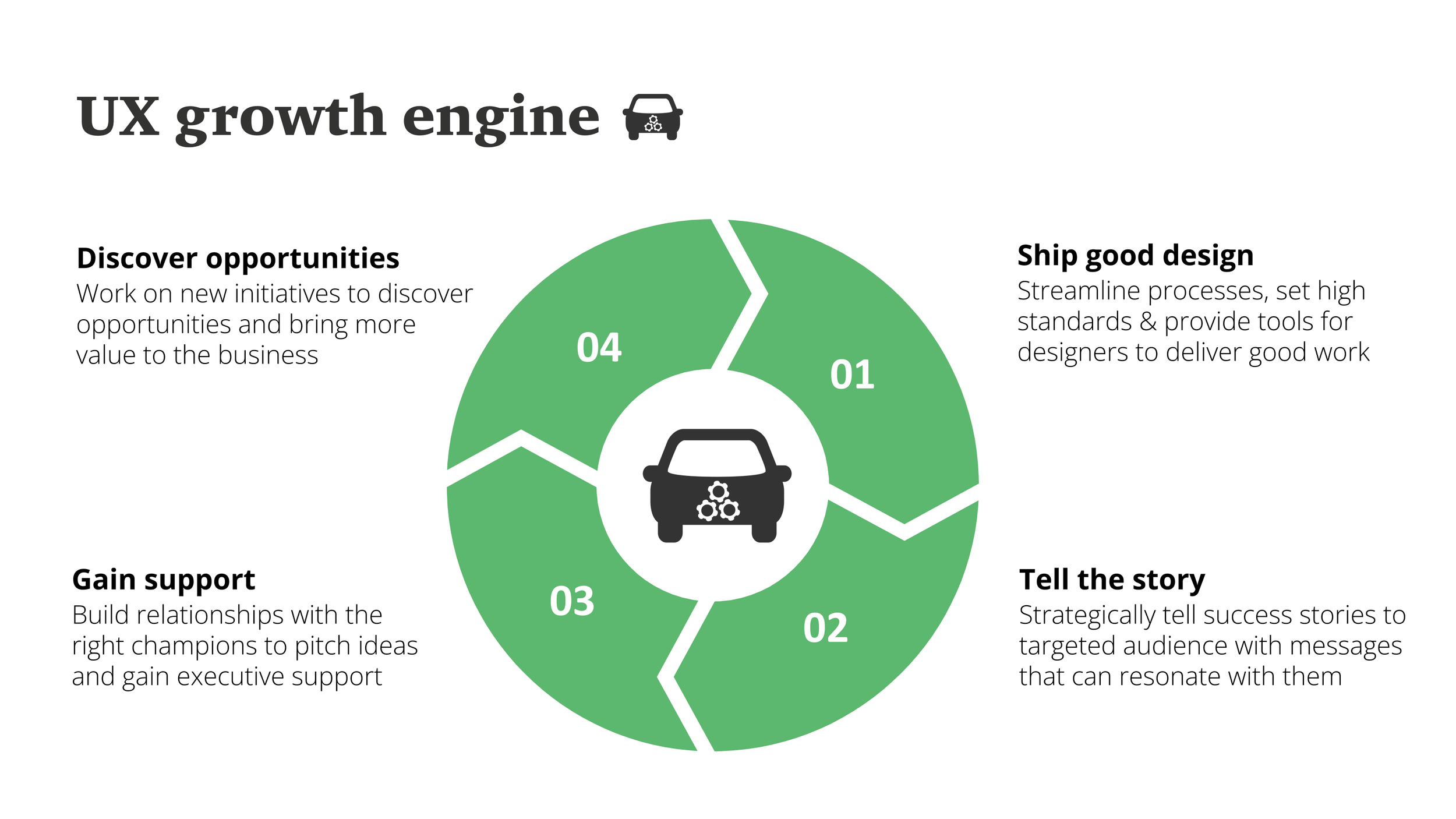
The most important part of this model is the UX engine. It is a self-sustaining loop that once set up properly, grows the UX team on its own with little need of outside interference. The loop consists of 4 components:
Ship good design — The baseline of any design team. Without shipping good design, nothing else matters. This can be achieved by setting high standards, principles, and governance
Tell the story — Develop UX presence within the organization by promoting ourselves to different target audiences.
Gain support — Build relationships with key executives to evangelize design and look for their direct support.
Discover opportunities — Proactively working on “design-driven” initiatives to discover opportunities that bring more value to the business.
-
Similar to a turbocharger in a car, turbo boosts are one-off events that accelerate UX team growth temporarily but don’t last. These tactics aren’t “engines,” because in most cases they aren’t sustainable and repeatable at scale.
However, Turbo Boosts can still be very valuable for kick-starting and accelerating growth, particularly when UX is not widely known and accepted within the company. They include things like:
Run big show and tell events about design with a massive audience
Co-creation workshops with senior leadership
Produce thought-leadership content such as articles or videos
-
Lubricants don’t drive UX growth directly, but instead optimize the efficiency of the engine. There are four broad categories of lubricants:
Process—Codifying how things should work and remove ambiguity. A well-defined process provides the greatest chance for repeatable success and consistent outcomes. Examples include: Standardizing design and review process, clear Definition of Ready, and Definition of Done.
Knowledge—Increase the collective intellect of the team such that designers are empowered to solve problems quickly on their own. This includes good practice of documenting product logic, learning & sharing programs, and soft-skills training.
Tools—Effective tooling amplifies the output of the team. Examples include building a design system, a clear intranet structure to make knowledge accessible, or even creating presentation templates to help designers sell the value of UX to stakeholders easier.
Relationship—Good relationships across the organization will make the designer’s life easier and allow them to have more impact in the long run. This includes bonding activities such as team lunch or drinks within the design team, and also social activities outside design such as exchange sessions with Engineering and the Product team.
-
No designers, no design. This involves hiring good people and keeping them as long as possible:
Securing resources on time and creating process to consistently hire top talent
Define career path for advancement, clear OKRs and assign projects appropriately according to individual strength and career aspiration
Provide benefits beyond standard company policy such as design training outside the organization
UX Growth Strategy
Where we were
We considered multiple facts about the team at that time:
New management — New senior executives have come on board. She was supportive of UX but didn’t know too much about us
Doing good work but no one knew — Our team has been shipping good work, but our team wasn’t well known within the organization
Not enough innovation work — We were doing a lot of work as assigned, but not leading and driving innovative work
Strategy workshop
I hosted a workshop with two other design managers to help us further align on where we think the design team fits in the organization. We focused on:
Identifying key players - What is our relationship with them in terms of leverage
Messaging - How do we currently sell ourselves to the key players
Authority - How much authority does the design team actually have


Our strategy
After analyzing our team’s situation, I came up with the following strategy:
Evangelize design (Turbo 💥 ) — Start with a Big Bang and be known to the organization. We want to be ultra-clear to key stakeholders on who we are and how we add value to the organization.
Deliver good work (The Engine ⚙️) — Focus on consistently delivering good design while making regular storytelling cadence part of our DNA. This will open doors to opportunities and will solve the problem of not having enough innovative work.
Optimize —Develop a process to streamline the way we work (Lubricants 💧) while keeping the team happy (Fuel ⛽).
UX Growth Roadmap
Backlog
To make the strategy work, we need to figure out exactly what we need to do and prioritize it. From our idea backlog, I created an “Initiative template” that helped us to articulate our ideas clearly:
Background — What triggers this idea?
Reason of significance — Why does this problem matter, why now?
Hypothesis — What is the imagined outcome?
Metrics — How do we measure success?
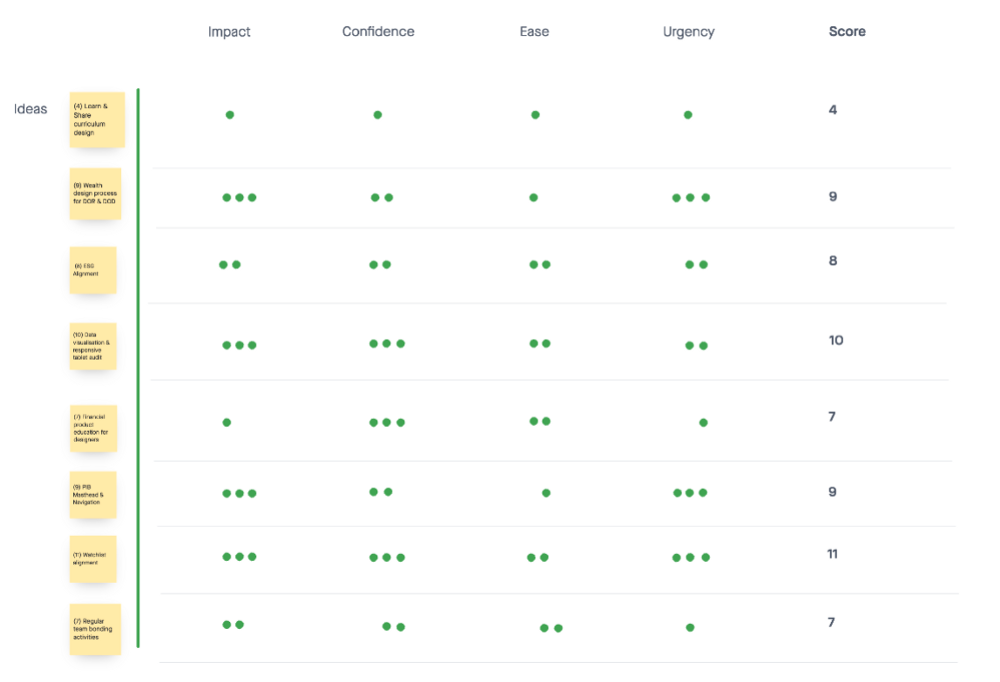
ICEU score — more on that in the next section
Definition of Done — When is this task considered completed?

Prioritization
I modified the ICE framework (added a U for Urgency) to help us score ideas and prioritize the ideas. The idea creator was asked to score each idea (from 1 lowest to 3 highest) based on the following criteria:
Impact: How much value we think this task will bring to our team
Confidence: How much do we believe in the idea will success
Ease: How easy is it to implement (the higher the score the easier)
Urgency: How time-sensitive is this idea (higher score the more urgent)
We then discussed and added the scores together.
Sort & Allocate
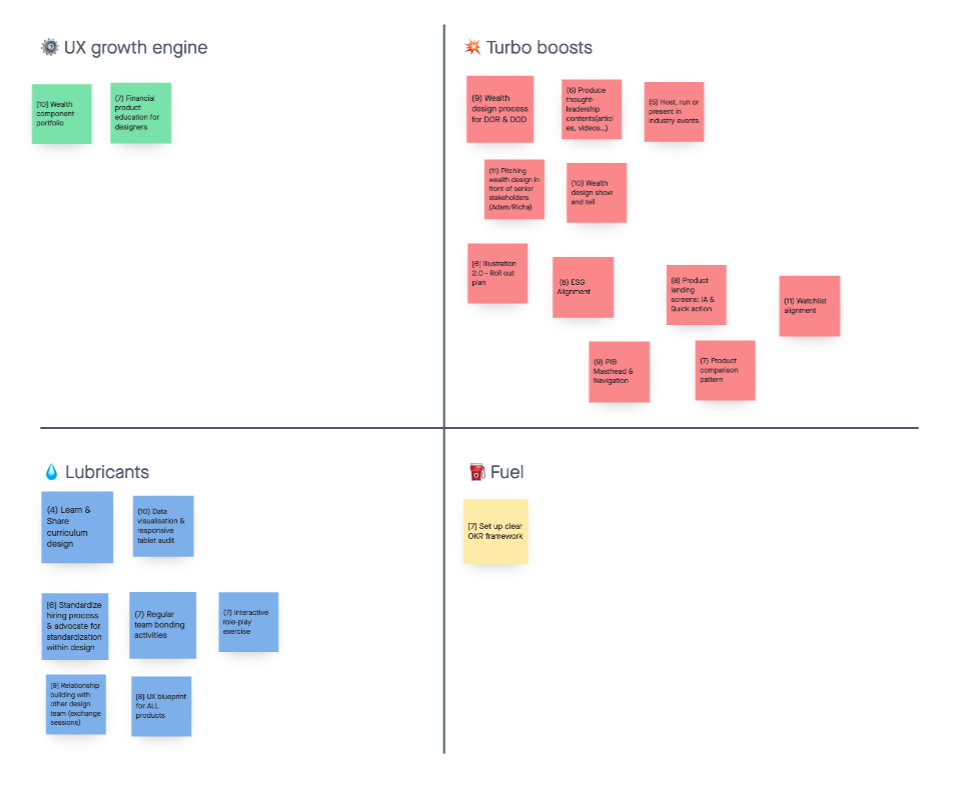
We sorted the ideas into quadrants to help us understand how the idea is contributing to the racecar growth framework.
I made sure the team was laser-focused on growth, ideas that didn’t contribute to the growth of the UX team were discarded.
Next is to sequence the work. We allocated our effort based on our strategy, roughly how many percentage of our time should be spent on each area of the racecar per quarter.
For example in Q2, we decided it would make sense to spend 60% of our time on Turbo, 30% on Lubricants, and 10% on the Engine.


Roadmap
Next, we moved the ideas into quarters according to the percentage decided. In descending order, the highest scores ideas going into Q2 and the lowest go into Q4.
Finally, a clear roadmap that communicates our focus for the year has come to life. The roadmap serves as our blueprint to keep us on track on exactly what to do to increase UX influence within the organization.
For the actual execution work, refer to the UX Management case-study.
Outcome
Measuring success
While I didn’t have the outcome from this strategy work since I left the role shortly after, I have identified a couple of areas to measure our impacts.
Number of design proposed projects - 93% of our current work is requested from the business side, as projects are the lifeline of project teams, we wanted to increase the number of design proposed lead project
Design maturity - Measured via internal survey to rate the UX team’s maturity against Nielson Noman Groups’ design maturity rating
Team satisfaction - NPR score of the team (Will they refer someone to the design team here), anonymous survey
Designer churn rate - Measure the 2-year churn rate of our permanent staff